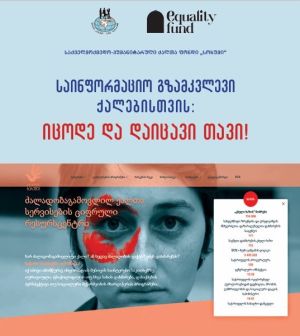
This information guide for women joins practical and essential information on responding to cases of violence, available services, hotlines, shelters, legal and psychosocial support.
The aim of the guide is to help women, community leaders, and active citizens quickly obtain reliable information on ways of assistance and support mechanisms, as well as to learn about opportunities for economic empowerment.
The project is implemented with the support the Equality Fund (Canada)
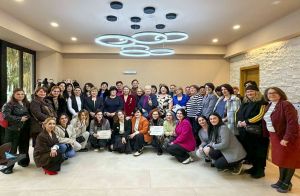
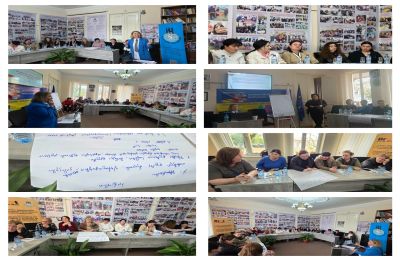
A final conference on "Women's Empowerment and Sustainable Mechanisms for Community Support: Experience, Results, and Impact" was held at “Gelati Residence” Hotel.
The meeting united 50 women from various municipalities: leaders and members of mutual assistance groups, paraprofessionals, participants of civic initiatives, and representatives of the Fund “Sukhumi”.
The women shared their experiences, achieved changes, and challenges during four thematic panels:
- Women's mutual assistance groups as a safe space for women's empowerment and digital skills development
- Civic initiatives implemented by the women that have led to real change in municipalities
- Paraprofessional support and its impact on women's lives
- Digital platforms and social networks to provide information on support services for women who have experienced violence, aiming at raising awareness and increasing access to services
The project evaluation showed that community-based support models strengthen social and economic inclusion, raise the importance of digital security and access to information, and build networks of mutual support and solidarity within communities.
At the end of the event, the awards were given to women who actively participated in the project.
The project is implemented with the support the Equality Fund (Canada)
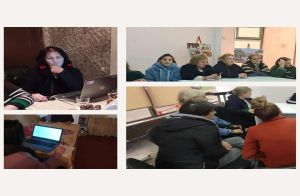
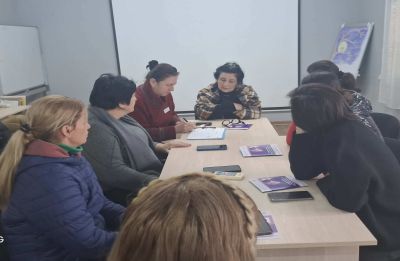
The mutual assistance group in Tskaltubo actively works within the framework of the project. Therefore, the group members easily summarized their activities. An online questionnaire was developed for evaluation, which the group members answered individually.
The meeting was also held online. The women's answers clearly demonstrated their achievements during their work, as well as the changes that had occurred in their lives and in the IDP community.
The group members noted that the initiatives were implemented in accordance with the needs of the communities, and the work, held during a year, was productive.
For example, these photos clearly demonstrate the difference - how the playground in the IDP settlement of Kopitnari was damaged. After restoration, children and young people will have a playground that meets modern standards.
The project is implemented by a coalition of non-governmental organizations: the Association of IDP Women "Consent," the Women's Information Center, and Charity Humanitarian Women Fund “Sukhumi”.
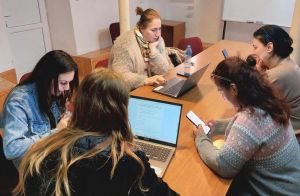
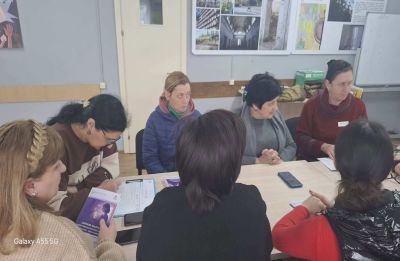
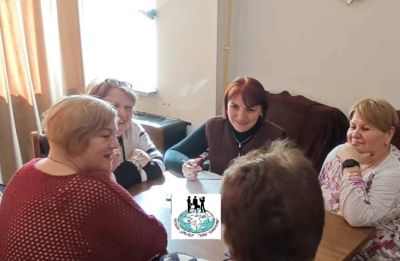
The aim of the ordinary meeting of Kutaisi Women's Mutual assistance Group was to summarize the project's results.
During the meeting, participants spoke with particular emotions about the process of implementing civic initiatives that played a significant role in creating an atmosphere of trust and gratitude in the IDP community.
The group members emphasize that, despite positive changes, the communities still have numerous needs, so they try to use all available resources and address existing challenges.
The project is implemented by a coalition of non-governmental organizations: the Association of IDP Women "Consent," the Women's Information Center, and Charity Humanitarian Women Fund “Sukhumi”.
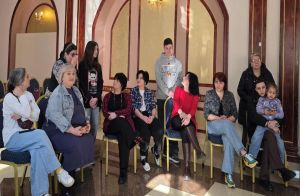
Retreat is a working meeting, a psychological and physical recharge, a vacation that will be pleasantly remembered by everyone.
The Fund “Sukhumi” staff spent three days with their families at “Borjomi Palace” Hotel (mostly there were children: kind, beautiful, and talented).
There were excursions to the Rabati Fortress, the Cathedral of St. Seraphim of Sarov, the Cathedral of St. George in the village of Sadgeri, and walks through Borjomi Park and the streets.
While working with psychologist Inna Ayrapetyan, the participants sought answers to the following questions: What is our current state? What factors negatively impact us? What can we influence? What can we change? Where can we find new strength and resources?
Of course, we "discovered" many internal resources, created and deciphered their "internal" and "external" masks, mastered new "self-defense" techniques, better understood each other, thought, cried, and laughed...
At the end, the children surprised us: they showed a scene from the forum-theater, danced, and recited poetry...
We realized: the resources are within us, in our families, and also in the beneficiaries, in those whom this organization helps, whom it tries to support for almost 30 years...
The project is implemented with the support of the organization Brot
für die Welt - Evangelischer Entwicklungsdienst (Germany)
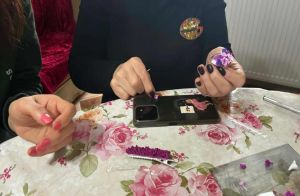
Women with difficult experiences come to the rehabilitation center: unresolved trauma, long-term stress, hopelessness, low self-esteem, and difficult social situations. However, behind these difficulties lies the ability to fight and faith in a better future.
In order to strengthen their faith, we offered the women a polymer clay master-class led by the trainer - Maka Jishkariani. The creative process was more than just a craft—it was a therapeutic experience, allowing them to discover their own abilities and activate their inner resources.
The workshop participants showed great interest. Each of them demonstrated natural talent and a great desire to better learn this direction.
The works created by them were filled with color, emotions and the hope of something new. This day became another step towards the changes.
The project is implemented with the support of the organization Brot
für die Welt - Evangelischer Entwicklungsdienst (Germany)
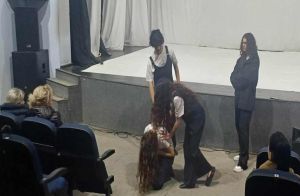
A woman shouldn't speak about her problems in public; she shouldn't speak publicly about family conflicts...
This is a stereotypical attitude toward violence. In such a situation, society becomes indifferent to women's problems.
Forum Theatre breaks these stereotypes...
Performances and active discussions clearly demonstrate to everyone that violence against women is a widespread problem and that women need protection, and that violence needs to be eradicated...
Forum Theatre held performances at Kutaisi Youth Center and in the central park. According to the audience, this way of presenting the problem is of great importance and serves to prevent violence.
The project is implemented with the support of the organization Brot
für die Welt - Evangelischer Entwicklungsdienst (Germany)
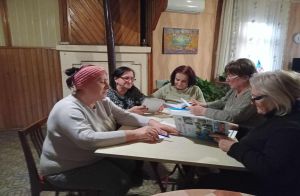
How actual is the problem of domestic violence in communities?
How informed is the public about victim support services?
How do they respond to cases of violence?
Where can they find information about existing services?
Active discussions on these issues were held at informational meetings initiated by the Women Support Centers of Khurcha (Zugdidi Municipality), Tskaltubo, and Tsalenjikha.
Paraprofessionals actively work with mobilizers to strengthen social work. In parallel with case identification, referrals are underway. Three women and their children will receive psychosocial support at our rehabilitation center.
Social work facilitates access to services, which is especially important for women at risk.
The project is implemented with the support of the organization Brot
für die Welt - Evangelischer Entwicklungsdienst (Germany)
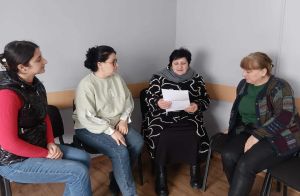
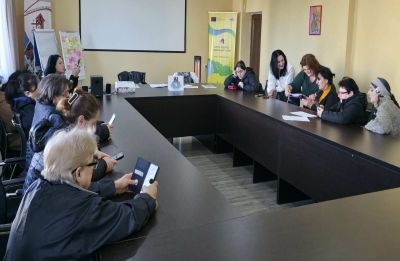
The aim of informational meetings held in Kutaisi and Senaki was to raise awareness among women and introduce them to resources that ensure the safety of women under the risk.
Participants received information about the forms and types of violence against women, as well as support services for victims of violence. They learned which hotlines are effective and why it is important to be aware of these services.
They noted that receiving such information is important, as people often do not realize that they can also become victims of online violence.
"We often don't realize that online harassment, stalking, or sharing personal information is a form of violence. Now we know whom to address for help."
According to the participants, such meetings help raise awareness in communities and promptly respond to cases of violence.
The project is implemented with the support of the organization Brot
für die Welt - Evangelischer Entwicklungsdienst (Germany)
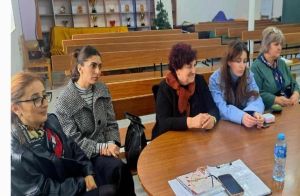
The problem of violence against women becomes even more pressing when the online space is added to it, offering even greater opportunities for violent control.
At meetings organized by Women Support Centers, special attention was paid to the threats posed by digital technologies. It was noted that violence is shown not only in the physical environment. This is a serious challenge online as well.
The meetings focused on the importance of accessing support services for victims of violence so they can protect themselves from such threats and receive the necessary assistance in a timely manner.
Participants noted:
"Women have poor information about digital violence, which exacerbates their feelings of insecurity."
"These meetings are very useful. We can use this awareness to combat this problem."
The project is implemented with the support of the organization Brot
für die Welt - Evangelischer Entwicklungsdienst (Germany)