
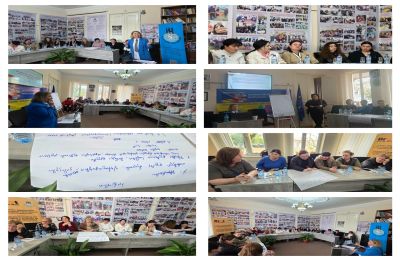
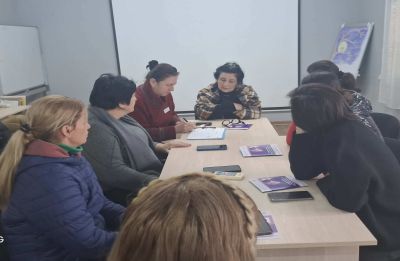
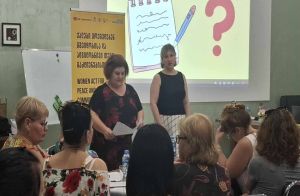
"Leadership for IDPs and rural women" - the second training on this topic was held in Zugdidi, at the “Dadiani Inn” hotel, with the participation of women - members of a mutual assistance group. This time the training was organized by the Women's Information Center, and members of mutual assistance groups from Senaki, Poti, Tsalenjikha, Mestia and Zugdidi took part in it.
The trainer and the participants discussed the essence and features of leadership, found out what positive changes the development of women's leadership will bring to the community, and emphasized the importance of self-presentation and public speaking.
The training was held within the framework of the project "Women Act for Peace and Strengthening the Local Community".
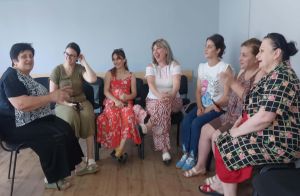
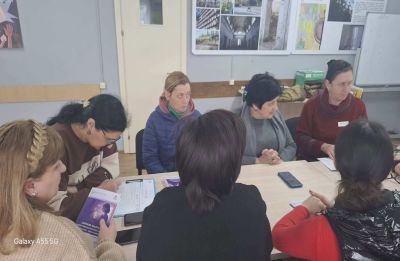
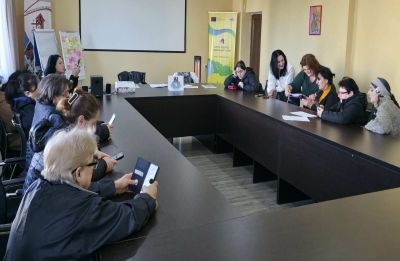
Members of Senaki mutual assistance group meet regularly and actively work in accordance with the activities defined by the project. The group members discussed the format and regulations for creating a fund/treasury. They discussed the forms of accounting for financial donations and the mechanisms for their use. Responsible persons, their rights and responsibilities were identified.
In order to improve their professional development and competence, the group members have already completed trainings on women's leadership, identification and prioritization of problems. One of the questions at the meeting was devoted to discussing the topic of women's leadership.
According to the group members, trainings on community leadership are important for their development and will contribute to the identification of priority problems and social change in IDP communities.
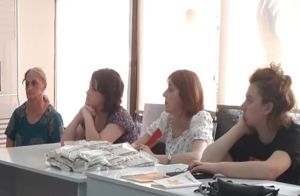
Women Support Centers understand how important it is to disseminate information about victim assistance services. In August, meetings with women's groups continued. In parallel with information, communication with beneficiaries continues.
Women have already addressed the mobilizers for help and consultations. Six new cases were recorded in the communities of Kutaisi, Khoni, Vani and Tsalenjikha. Identification of new cases means that assistance opportunities have expanded. Each woman has already received information about who to contact and what services to use.
Para-specialists of the centers are actively involved in the identification process. The success of social work depends on the trust of the beneficiaries and the desire to cooperate.
The project is implemented with the support of the organization Brot
für die Welt - Evangelischer Entwicklungsdienst (Germany)
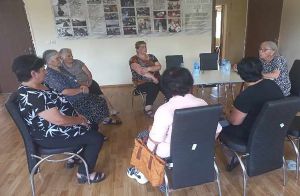
Women support centers actively worked in various communities and held informational meetings. Mobilizers provided participants with information about services and programs for victim assistance.
During the informational meetings, priority issues were identified that were relevant for communities in terms of violence against women. Participants of the meetings in Senaki, Khobi, Chokhatauri, Terjola, Tskaltubo and Zugdidi emphasized the need to support women who have suffered from violence so that they do not feel alone.
In August, five families under the risk group were identified - all families became active users of the services of the Fund “Sukhumi”. The participants of the meetings disseminate the information received, which helps attract new beneficiaries and is important for the prevention of violence.
The project is implemented with the support of the organization Brot
für die Welt - Evangelischer Entwicklungsdienst (Germany)
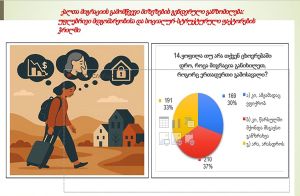
In July, civil dialogue was continued in women's groups of Kutaisi, Khoni and Khobi. Participants discussed the reasons of migration, its psychosocial consequences and ways of prevention.
Their vision of what needs to be done to reduce migration and mitigate its consequences, reintegrate women and improve the psychosocial climate in their families was interesting; increase of teachers' awareness of the emotional and behavioral characteristics of children of migrant parents was also noted. Some participants shared their experiences on this topic:
"My parents' emigration brought a lot of psychological trauma, some of which I still experience. What children of immigrant parents need most is the right atmosphere." "The school period should be useful for them, because it was the teacher who brought the light back to me."
Some participants expressed a desire to share their emotions:
"I have some sketches and you can share them. If I could, I would give everyone the strength to talk about their pain, as I do."
"I would be happy to join the creation of interesting stories. I myself have a short but painful experience of migration. I know many others who would be happy to share their emotions."
The project is implemented with the support of the organization Brot
für die Welt - Evangelischer Entwicklungsdienst (Germany)
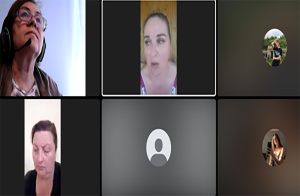
Preparation for the implementation of civil initiatives has begun in the women's groups of Kutaisi, Khoni and Khobi. It was preceded by a civil dialogue on the causes of migration, its psychosocial consequences and ways of prevention.
During the meetings they heard interesting opinions from young people who have their own attitude to this problem and believe that there are many sensitive topics, the understanding of which is extremely important for society. For example, according to their observations, parents sometimes unintentionally contribute to the alienation of their children from their peers by buying expensive things, which further aggravates their psycho-emotional state.
At this stage, consultations are being held with initiative groups, events are being planned and appropriate resources are being sought.
The project is implemented with the support of the organization Brot
für die Welt - Evangelischer Entwicklungsdienst (Germany)
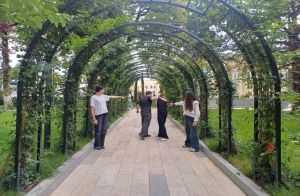
Performing in the open air, even in hot July, is a good experience for our youth.
Forum Theatre held two performances in Kutaisi: in the renovated Central Park and in Veriko Anjaparidze Park.
Unfortunately, the audience refrains from taking photos...
The main thing is that they join the discussion, share the slogans of the Forum Theatre: violence is unacceptable, violence and bullying cannot be tolerated, people who have suffered from violence must be protected...
The reaction of foreign guests of the city was especially impressive when the actors introduced them to the essence and goals of the Forum Theatre in English.
The project is implemented with the support of the organization Brot
für die Welt - Evangelischer Entwicklungsdienst (Germany)
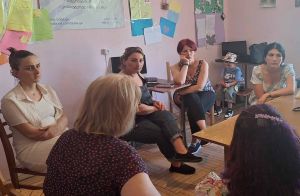
Needs, desires and moods of Women are best revealed during meetings with them. Meetings are held monthly at Women Support Centers. The topics discussed are mainly related to problems of domestic violence.
During the meetings with women's groups in Tskaltubo, Khoni, Terjola and Vani, the participants discussed various problems:
- A significant part of women emigrated. Unfortunately, there are many single-parent families. Children have psychological problems.
- Women are unemployed and social assistance is insufficient. In such families, conflicts often arise due to social problems.
After discussing common problems, work on individual issues begins. Thanks to the intervention of mobilizers, three beneficiaries in Terjola, Vani and Tskaltubo solved their problems. Solving these problems required the involvement of a social worker, a lawyer and a psychologist.
The project is implemented with the support of the organization Brot
für die Welt - Evangelischer Entwicklungsdienst (Germany)
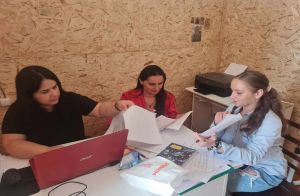
The rate of identification of cases of violence in Women Support Centers has increased. This was facilitated by the work of Para-specialists. 12 cases were identified during a month. As a result of social work, more than 150 beneficiaries received information about victim support services. Women receive consultations on both legal and psychological issues. The Centers' mobilizers are constantly with them.
Out of 12 cases, the condition of ten beneficiaries improved due to the involvement of a psychologist, and two continue to work with a lawyer on legal issues.
Two women together with their children underwent psycho-rehabilitation at the Rehabilitation Center of our organization: their stable condition is the result of comprehensive work of all the employees of the Center.
The women's reviews:
"When you know exactly whom to address and do not waste time on it, this is important assistance."
"I am a single mother, my social assistance was stopped, I did not know whom to address. Representatives of the Fund “Sukhumi” helped me.
The project is implemented with the support of the organization Brot
für die Welt - Evangelischer Entwicklungsdienst (Germany)
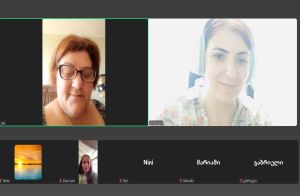
Teenagers from ten municipalities of Western Georgia are actively participating in an online course on conflict management and violence prevention. Among their peers, they openly talk about challenges, stereotypes and the desire for change.
"I understand that the more I learn, the more I want to tell others. I want to protect myself and help others," said one of the participants.
Young people want to become ambassadors of peace in their regions and authors of positive changes.
The project is implemented with the support of the organization Brot
für die Welt - Evangelischer Entwicklungsdienst (Germany)